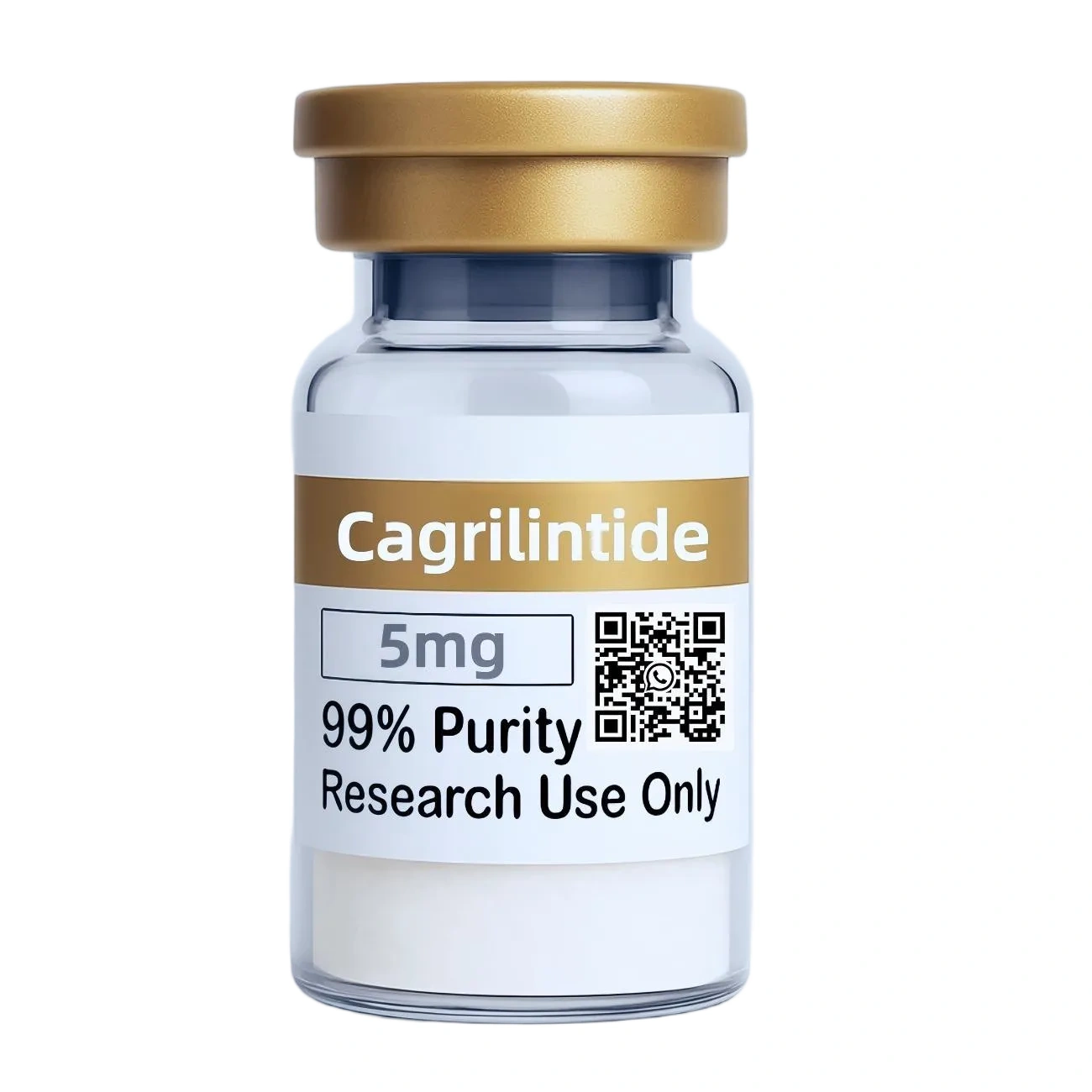
Dual amylin/GLP-1 receptor agonist combination. Subject of clinical investigation examining complementary mechanisms in metabolic research.
Cagrilintide + Semaglutide is listed in our china peptide catalog as a finished research compound from an established Chinese manufacturer. It is catalogued under the Weight Management, Blends
Quality & Testing
Testing method: HPLC / LC-MS . Products are supplied against the specification shown on the applicable product page. The standard catalog purity specification is ≥98% unless otherwise stated. Product-specific specifications and quality-control information may vary by compound and batch. Every batch is tested by the manufacturer for purity and concentration as part of routine quality control, using methods such as HPLC and LC-MS. These results are kept in the manufacturer’s internal quality-control records and are not issued as a separate certificate or document.
Research Areas
Dual-Receptor Pharmacology Research interest in CagriSema centers on whether simultaneous amylin and GLP-1 receptor engagement produces additive or synergistic effects on metabolic endpoints. Studies have examined receptor expression patterns in brainstem and hypothalamic regions, with particular attention to whether the two pathways share downstream signaling nodes or operate independently — a key mechanistic question for combination metabolic research. Body Weight and Composition Research Preclinical studies in diet-induced obesity models have examined the combination’s effects on fat mass reduction, lean mass preservation, and body weight trajectories. The research question driving much of this work is whether dual-pathway satiety signaling produces greater outcomes than either agent in isolation — and whether the mechanisms are truly complementary or partially redundant. Metabolic Parameter Studies Studies have investigated glycemic markers, insulin sensitivity, glucagon levels, and gastric emptying rate in rodent models receiving the combination. The distinct receptor mechanisms of each component — amylin’s primary role in glucagon suppression versus GLP-1’s insulin secretagogue and gastric emptying effects — provides a basis for examining independent versus overlapping metabolic contributions. ## Sourcing Cagrilintide + Semaglutide From China
Cagrilintide + Semaglutide is available through our platform as a china peptide sourced directly from an established Chinese manufacturer. Three points define how we handle it:
- Factory-direct, not trader-sourced. We confirm availability and specification with the manufacturer before the order is confirmed. There is no intermediary resale of unknown-origin vials in this catalog.
- Specification before shipment. The purity and concentration specification shown on this page is the manufacturer’s batch specification. Product-specific quality-control information travels with the order.
- Research-use discipline. Like every listing in our catalog, Cagrilintide + Semaglutide is supplied for laboratory research use only, under strict research-use terms.
For buyers comparing chinese peptides suppliers, the practical test is whether the seller can name the manufacturer and show the batch documentation. We work the other way around: the manufacturer and the documentation are the offer. Browse the full catalog or see how sourcing works.
Available Variants
| Name | Strength | Pack Size | Purity | Availability |
|---|---|---|---|---|
| Cagrilintide 5mg + Semaglutide 5mg | 10 mg | 10 vials | ≥98% | In Stock |
Specification Highlights
Quality & Testing
Testing method: HPLC / LC-MS . Products are supplied against the specification shown on the applicable product page. The standard catalog purity specification is ≥98% unless otherwise stated. Product-specific specifications and quality-control information may vary by compound and batch. Every batch is tested by the manufacturer for purity and concentration as part of routine quality control, using methods such as HPLC and LC-MS. These results are kept in the manufacturer’s internal quality-control records and are not issued as a separate certificate or document.
Research Areas
Dual-Receptor Pharmacology Research interest in CagriSema centers on whether simultaneous amylin and GLP-1 receptor engagement produces additive or synergistic effects on metabolic endpoints. Studies have examined receptor expression patterns in brainstem and hypothalamic regions, with particular attention to whether the two pathways share downstream signaling nodes or operate independently — a key mechanistic question for combination metabolic research. Body Weight and Composition Research Preclinical studies in diet-induced obesity models have examined the combination’s effects on fat mass reduction, lean mass preservation, and body weight trajectories. The research question driving much of this work is whether dual-pathway satiety signaling produces greater outcomes than either agent in isolation — and whether the mechanisms are truly complementary or partially redundant. Metabolic Parameter Studies Studies have investigated glycemic markers, insulin sensitivity, glucagon levels, and gastric emptying rate in rodent models receiving the combination. The distinct receptor mechanisms of each component — amylin’s primary role in glucagon suppression versus GLP-1’s insulin secretagogue and gastric emptying effects — provides a basis for examining independent versus overlapping metabolic contributions.
Compound Profile
The cagrilintide-semaglutide combination — commonly referenced as CagriSema in clinical research — pairs a long-acting amylin analogue (cagrilintide) with a GLP-1 receptor agonist (semaglutide) in a fixed-ratio co-formulation. The research rationale centers on mechanistic complementarity: amylin receptors and GLP-1 receptors are expressed in distinct but overlapping regions of the hypothalamus and brainstem, with additive or potentially synergistic effects on satiety signaling hypothesized from dual-pathway engagement. Preclinical studies in rodent models of diet-induced obesity have examined the combination’s effects on body weight reduction, food intake, and metabolic parameters. The central hypothesis is that simultaneous amylinergic (hindbrain area postrema, nucleus tractus solitarius) and GLP-1 receptor (hypothalamic arcuate nucleus, ventromedial nucleus) signaling produces greater metabolic response than either pathway alone. This dual-receptor approach represents a broader trend in metabolic peptide research toward multi-target strategies. Peptides of China supplies cagrilintide and semaglutide as individual lyophilized powders, each at 99%+ purity verified by HPLC and Mass Spectrometry, allowing researchers to formulate the combination at custom ratios. Certificates of Analysis accompany every batch. All products are for laboratory research use only and are not for human consumption.
Profile
Combination Components Cagrilintide (amylin analogue) + Semaglutide (GLP-1 RA) Receptor Targets AMY1/2/3 (amylin) + GLP-1R (glucagon-like peptide-1 receptor) Clinical Designation CagriSema
Research Areas
Metabolic research, dual-agonism pharmacology, energy homeostasis, body composition Administration Form Individual lyophilized powders for co-administration
Available Variants
| Name | Strength | Pack Size | Purity | Availability |
|---|---|---|---|---|
| Cagrilintide 5mg + Semaglutide 5mg | 10 mg | 10 vials | ≥98% | In Stock |
Specification Highlights
Quality & Testing
Testing method: HPLC / LC-MS . Products are supplied against the specification shown on the applicable product page. The standard catalog purity specification is ≥98% unless otherwise stated. Product-specific specifications and quality-control information may vary by compound and batch. Every batch is tested by the manufacturer for purity and concentration as part of routine quality control, using methods such as HPLC and LC-MS. These results are kept in the manufacturer’s internal quality-control records and are not issued as a separate certificate or document.
Research Areas
Dual-Receptor Pharmacology Research interest in CagriSema centers on whether simultaneous amylin and GLP-1 receptor engagement produces additive or synergistic effects on metabolic endpoints. Studies have examined receptor expression patterns in brainstem and hypothalamic regions, with particular attention to whether the two pathways share downstream signaling nodes or operate independently — a key mechanistic question for combination metabolic research. Body Weight and Composition Research Preclinical studies in diet-induced obesity models have examined the combination’s effects on fat mass reduction, lean mass preservation, and body weight trajectories. The research question driving much of this work is whether dual-pathway satiety signaling produces greater outcomes than either agent in isolation — and whether the mechanisms are truly complementary or partially redundant. Metabolic Parameter Studies Studies have investigated glycemic markers, insulin sensitivity, glucagon levels, and gastric emptying rate in rodent models receiving the combination. The distinct receptor mechanisms of each component — amylin’s primary role in glucagon suppression versus GLP-1’s insulin secretagogue and gastric emptying effects — provides a basis for examining independent versus overlapping metabolic contributions.