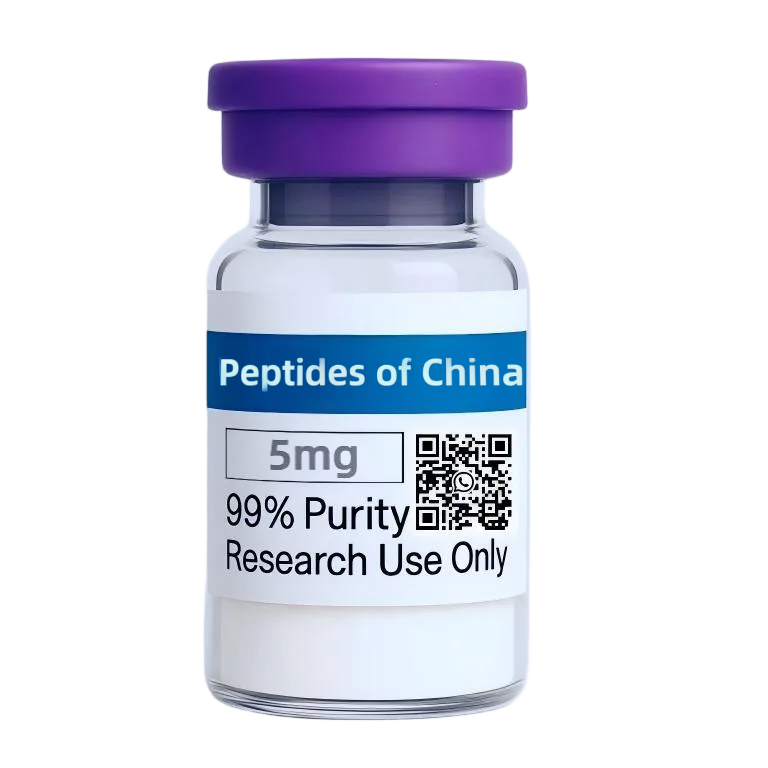
HGH Fragment 176-191 research peptide sourced directly from verified Chinese manufacturer. Purity and concentration verified per batch.
HGH Fragment 176-191 is a research compound available through our china peptide catalog as a finished, lyophilized vial from an established Chinese manufacturer. It belongs to the GH C-terminal Fragment / Lipolytic Peptide
Available Variants
| Name | Strength | Pack Size | Purity | Availability |
|---|---|---|---|---|
| HGH Fragment 176-191 | 2 mg | 10 vials | ≥98% | In Stock |
| HGH Fragment 176-191 | 5 mg | 10 vials | ≥98% | In Stock |
| HGH Fragment 176-191 | 5 mg | 10 vials | — | In Stock |
Specification Highlights
Quality & Testing
Testing method: HPLC / LC-MS . Products are supplied against the specification shown on the applicable product page. The standard catalog purity specification is ≥98% unless otherwise stated. Product-specific specifications and quality-control information may vary by compound and batch. Every batch is tested by the manufacturer for purity and concentration as part of routine quality control, using methods such as HPLC and LC-MS. These results are kept in the manufacturer’s internal quality-control records and are not issued as a separate certificate or document.
Variant Notes
Peptide fragment of the C-terminal region of growth hormone. Research interest concerns its role in lipid metabolism regulation and differences between the activity of individual fragments and the full-length hormone.
Research Areas
Selective Lipolysis & Adipose Biology The primary research interest in HGH Fragment 176-191 is its capacity to stimulate lipolysis — fatty acid mobilisation from adipocytes — without activating the full GH receptor and its downstream anabolic and mitogenic pathways. In vitro experiments using primary rat adipocytes and 3T3-L1 differentiated fat cells show dose-dependent stimulation of glycerol and free fatty acid release. Crucially, the fragment does not compete with native GH at the GH receptor in binding competition assays, suggesting an alternative binding site or indirect mechanism. Comparative studies with intact GH use the fragment as a tool to isolate the lipolytic signalling pathway from IGF-1-dependent growth responses. IGF-1 Independence & Glucose Metabolism Native GH administration elevates both IGF-1 and causes transient insulin resistance in glucose tolerance models. HGH Fragment 176-191 studies in rodent obesity models report an absence of significant IGF-1 elevation and no glucose intolerance at doses producing measurable changes in adipose mass. This IGF-1 independence is mechanistically significant for research designs that need to examine fat-specific metabolic endpoints without confounding growth factor activity. Oral glucose tolerance tests (OGTT) in treated versus control obese rodents are a standard assay used to confirm this selectivity profile. Bone Metabolism Research In vitro studies using osteoblast-like cell lines (MG-63, Saos-2) and primary calvarial osteoblasts have characterised HGH Fragment 176-191’s effects on alkaline phosphatase activity, collagen synthesis, and osteocalcin expression — markers of osteoblast differentiation and matrix mineralisation. Osteoclast resorption assays using dentine slice systems have also been used to characterise whether the fragment modulates bone resorption independently of its lipolytic activity. These studies position the fragment as a tool for investigating GH-independent mechanisms of bone metabolism regulation. Anti-obesity Phenotyping in Rodent Models Diet-induced obesity (DIO) and leptin-deficient (ob/ob) mouse models have been used to characterise HGH Fragment 176-191’s effects on whole-body adiposity, measured by MRI body composition analysis and dual-energy X-ray absorptiometry (DEXA). Studies report preferential reductions in visceral adipose tissue versus subcutaneous depots in some rodent protocols, though the mechanistic basis for depot selectivity (if real) remains under investigation. Pair-feeding controls and pair-injected groups are used to separate direct metabolic effects from secondary changes in food intake. ## Sourcing HGH Fragment 176-191 From China
HGH Fragment 176-191 is available through our platform as a china peptide sourced directly from an established Chinese manufacturer. Three points define how we handle it:
- Factory-direct, not trader-sourced. We confirm availability and specification with the manufacturer before the order is confirmed. There is no intermediary resale of unknown-origin vials in this catalog.
- Specification before shipment. The purity and concentration specification shown on this page is the manufacturer’s batch specification. Product-specific quality-control information travels with the order.
- Research-use discipline. Like every listing in our catalog, HGH Fragment 176-191 is supplied for laboratory research use only, under strict research-use terms.
For buyers comparing chinese peptides suppliers, the practical test is whether the seller can name the manufacturer and show the batch documentation. We work the other way around: the manufacturer and the documentation are the offer. Browse the full catalog or see how sourcing works.
Compound Profile
HGH Fragment 176-191 is a synthetic 16-amino acid peptide corresponding to the C-terminal region of human growth hormone (residues 176–191 of the 191 AA mature sequence). It was isolated following observations that the lipolytic activity of GH — stimulation of fat breakdown — could be attributed to the C-terminal region, while the growth-promoting and IGF-1-stimulating activity resided in the N-terminal domain. Structurally, the fragment retains a disulfide bridge between Cys-182 and Cys-189, which is essential for its biological activity. This selective structural correspondence is the foundation of research into the fragment as a tool for dissecting GH’s metabolic actions from its anabolic effects. Preclinical research in rodent models of obesity has examined HGH Fragment 176-191’s effects on adipose tissue lipolysis and lipogenesis. Studies using radiolabelled glucose and fatty acids in fat cells demonstrate that the fragment stimulates fatty acid release from isolated adipocytes at a potency reportedly 12-fold greater than native GH in in vitro fat cell assays, without detectable IGF-1 elevation or glucose intolerance in short-duration protocols. The absence of GH receptor activation by the fragment — confirmed by receptor binding assays — distinguishes it mechanistically from intact GH in metabolic studies. Bone metabolism research represents a separate line of investigation, with in vitro osteoblast and osteoclast models used to characterise the fragment’s effects on bone formation markers. Peptides of China supplies HGH Fragment 176-191 as lyophilized powder at ≥98% purity verified by HPLC and confirmed by mass spectrometry. Certificates of Analysis are available per batch. Wholesale quantities available on request. This compound is intended for laboratory research use only and is not for human administration.
Profile
Available Variants
| Name | Strength | Pack Size | Purity | Availability |
|---|---|---|---|---|
| HGH Fragment 176-191 | 2 mg | 10 vials | ≥98% | In Stock |
| HGH Fragment 176-191 | 5 mg | 10 vials | ≥98% | In Stock |
| HGH Fragment 176-191 | 5 mg | 10 vials | — | In Stock |
Specification Highlights
Quality & Testing
Testing method: HPLC / LC-MS . Products are supplied against the specification shown on the applicable product page. The standard catalog purity specification is ≥98% unless otherwise stated. Product-specific specifications and quality-control information may vary by compound and batch. Every batch is tested by the manufacturer for purity and concentration as part of routine quality control, using methods such as HPLC and LC-MS. These results are kept in the manufacturer’s internal quality-control records and are not issued as a separate certificate or document.
Variant Notes
Peptide fragment of the C-terminal region of growth hormone. Research interest concerns its role in lipid metabolism regulation and differences between the activity of individual fragments and the full-length hormone.
Research Areas
Selective Lipolysis & Adipose Biology The primary research interest in HGH Fragment 176-191 is its capacity to stimulate lipolysis — fatty acid mobilisation from adipocytes — without activating the full GH receptor and its downstream anabolic and mitogenic pathways. In vitro experiments using primary rat adipocytes and 3T3-L1 differentiated fat cells show dose-dependent stimulation of glycerol and free fatty acid release. Crucially, the fragment does not compete with native GH at the GH receptor in binding competition assays, suggesting an alternative binding site or indirect mechanism. Comparative studies with intact GH use the fragment as a tool to isolate the lipolytic signalling pathway from IGF-1-dependent growth responses. IGF-1 Independence & Glucose Metabolism Native GH administration elevates both IGF-1 and causes transient insulin resistance in glucose tolerance models. HGH Fragment 176-191 studies in rodent obesity models report an absence of significant IGF-1 elevation and no glucose intolerance at doses producing measurable changes in adipose mass. This IGF-1 independence is mechanistically significant for research designs that need to examine fat-specific metabolic endpoints without confounding growth factor activity. Oral glucose tolerance tests (OGTT) in treated versus control obese rodents are a standard assay used to confirm this selectivity profile. Bone Metabolism Research In vitro studies using osteoblast-like cell lines (MG-63, Saos-2) and primary calvarial osteoblasts have characterised HGH Fragment 176-191’s effects on alkaline phosphatase activity, collagen synthesis, and osteocalcin expression — markers of osteoblast differentiation and matrix mineralisation. Osteoclast resorption assays using dentine slice systems have also been used to characterise whether the fragment modulates bone resorption independently of its lipolytic activity. These studies position the fragment as a tool for investigating GH-independent mechanisms of bone metabolism regulation. Anti-obesity Phenotyping in Rodent Models Diet-induced obesity (DIO) and leptin-deficient (ob/ob) mouse models have been used to characterise HGH Fragment 176-191’s effects on whole-body adiposity, measured by MRI body composition analysis and dual-energy X-ray absorptiometry (DEXA). Studies report preferential reductions in visceral adipose tissue versus subcutaneous depots in some rodent protocols, though the mechanistic basis for depot selectivity (if real) remains under investigation. Pair-feeding controls and pair-injected groups are used to separate direct metabolic effects from secondary changes in food intake.