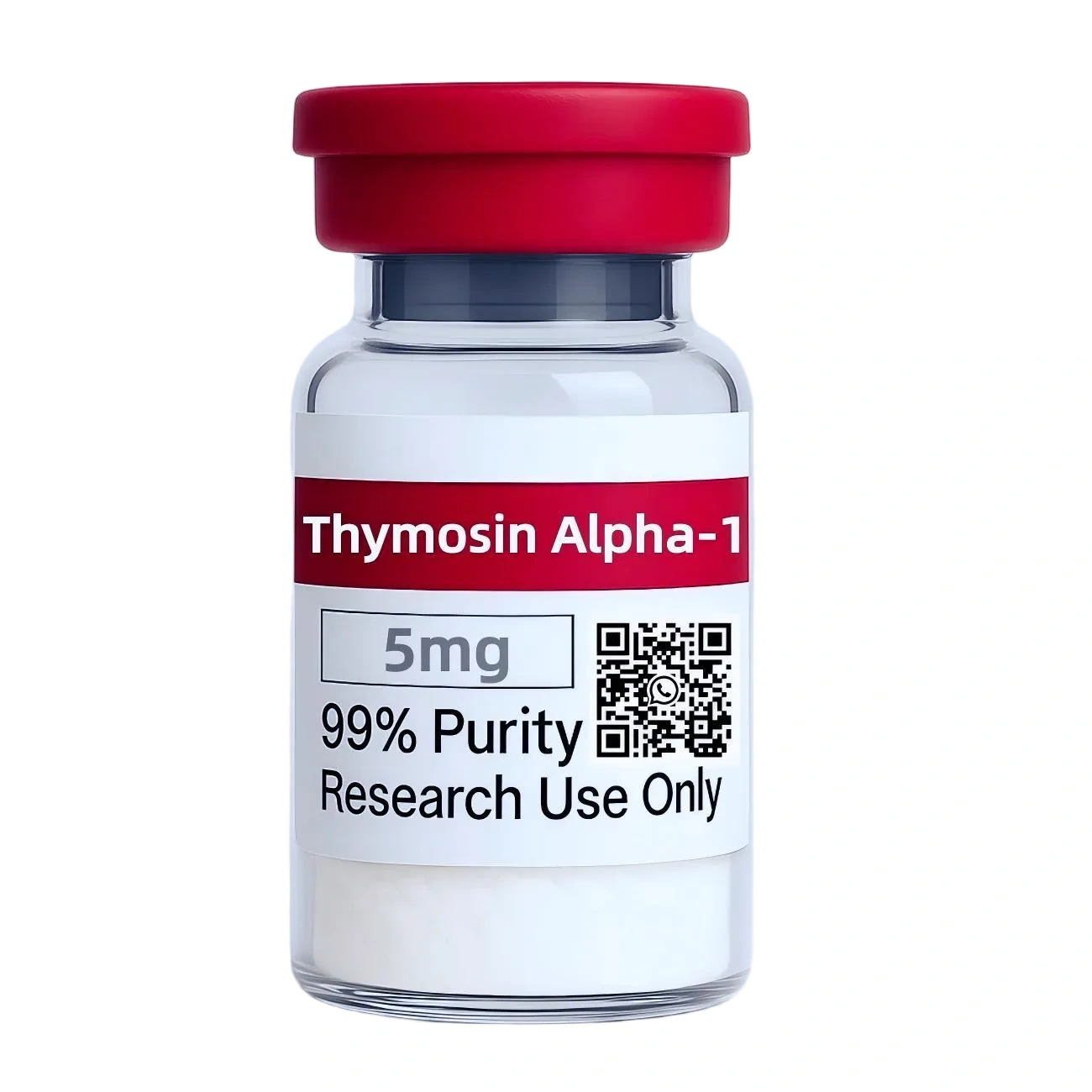
Thymosin Alpha-1 immunomodulatory peptide sourced from verified Chinese manufacturer. Purity tested per batch, HPLC tested. Wholesale pricing.
Thymosin Alpha-1 is a research compound available through our china peptide catalog as a finished, lyophilized vial from an established Chinese manufacturer. It belongs to the Thymic Immunomodulatory Peptide
Available Variants
| Name | Strength | Pack Size | Purity | Availability |
|---|---|---|---|---|
| Thymosin Alpha-1 | 5 mg | 10 vials | ≥98% | In Stock |
| Thymosin Alpha-1 | 5 mg | 10 vials | — | In Stock |
| Thymosin Alpha-1 | 10 mg | 10 vials | ≥98% | In Stock |
| Thymosin Alpha-1 | 10 mg | 10 vials | — | In Stock |
Specification Highlights
Quality & Testing
Testing method: HPLC / LC-MS . Products are supplied against the specification shown on the applicable product page. The standard catalog purity specification is ≥98% unless otherwise stated. Product-specific specifications and quality-control information may vary by compound and batch. Every batch is tested by the manufacturer for purity and concentration as part of routine quality control, using methods such as HPLC and LC-MS. These results are kept in the manufacturer’s internal quality-control records and are not issued as a separate certificate or document.
Research Areas
T-Cell Maturation & Thymic Biology Thymosin Alpha-1 was originally characterised through its ability to restore T-cell rosette formation and mitogen responsiveness in thymectomised mice — the seminal assay that established the thymus-derived nature of the activity. Contemporary models use it to characterise T-cell subset maturation (naïve CD4⁺/CD8⁺ development, Treg induction) in thymus-deficient models including neonatal thymectomy, nude mice, and in vitro thymic organoid systems. TLR-9 activation by Tα1 in plasmacytoid dendritic cells triggers type I interferon production and downstream T-cell activation — a mechanism established using TLR-9 knockout macrophage and dendritic cell assays. Antiviral Immune Response Research The clinical development of Thymosin Alpha-1 focused primarily on viral hepatitis — hepatitis B and C — where immune exhaustion and defective T-cell responses are central to viral persistence. In vitro models using peripheral blood mononuclear cells (PBMCs) from chronic hepatitis B patients show Tα1-induced enhancement of IFN-γ and IL-2 production by HBsAg-stimulated T cells. Murine hepatitis B and C surrogate models (HBV-transgenic mice, LCMV chronic infection models used as immune exhaustion models) use Tα1 to characterise recovery of virus-specific T-cell responses. SARS-CoV-2 infection research has also revisited Tα1 as a potential modulator of the dysregulated innate immune response in severe COVID-19. Sepsis & Immune Paralysis Models Sepsis-associated immunosuppression — characterised by exhausted lymphocytes, monocyte deactivation, and increased regulatory T-cell activity — has been modelled in cecal ligation and puncture (CLP) and endotoxaemia rodent models. Thymosin Alpha-1 administration in these models is reported to reduce bacterial burden and improve survival, associated with restored NK cell cytotoxicity, improved monocyte HLA-DR expression, and reduced IL-10/TNF-α ratios. These studies position Tα1 as a tool for investigating immune paralysis reversal mechanisms rather than broad immunostimulation. Cancer Immunology & Checkpoint Research Emerging research examines Thymosin Alpha-1’s effects on immune checkpoint molecule expression in tumour-bearing models. Studies in murine solid tumour models (LLC, 4T1) and in vitro human PBMC-tumour co-culture systems report Tα1-associated reductions in PD-1 expression on CD8⁺ T cells and enhanced tumour-infiltrating lymphocyte (TIL) activity. This is studied in the context of whether immune restorative peptides can sensitise exhausted T cells in the tumour microenvironment to checkpoint blockade, complementing rather than replacing anti-PD-1 therapy in combination protocols. ## Sourcing Thymosin Alpha-1 From China
Thymosin Alpha-1 is available through our platform as a china peptide sourced directly from an established Chinese manufacturer. Three points define how we handle it:
- Factory-direct, not trader-sourced. We confirm availability and specification with the manufacturer before the order is confirmed. There is no intermediary resale of unknown-origin vials in this catalog.
- Specification before shipment. The purity and concentration specification shown on this page is the manufacturer’s batch specification. Product-specific quality-control information travels with the order.
- Research-use discipline. Like every listing in our catalog, Thymosin Alpha-1 is supplied for laboratory research use only, under strict research-use terms.
For buyers comparing chinese peptides suppliers, the practical test is whether the seller can name the manufacturer and show the batch documentation. We work the other way around: the manufacturer and the documentation are the offer. Browse the full catalog or see how sourcing works.
Compound Profile
Thymosin Alpha-1 (Tα1) is a 28-amino acid peptide originally isolated from thymosin fraction 5 — a calf thymus extract — by Allan Goldstein and colleagues in the 1970s. The mature peptide carries an N-terminal acetyl group (Ac-Ser-) and encompasses the N-terminal sequence of prothymosin alpha, from which it is proteolytically released in vivo. Thymosin Alpha-1 is produced primarily in thymic epithelial cells and circulates at low nanomolar concentrations in healthy individuals, with levels declining progressively with age — a pattern that has driven its investigation as an immune restorative agent. The compound is distinguished from other thymic peptides by its well-characterised receptor interactions, most notably its activation of Toll-like receptors (TLR-2, TLR-9) and dendritic cell maturation pathways. The most extensively researched applications of Thymosin Alpha-1 are in infectious disease and immune dysfunction models. It received regulatory approval in multiple Asian and Eastern European markets for treatment of hepatitis B and hepatitis C, providing a substantial clinical pharmacology dataset including human PK, immunological endpoints (NK cell activity, T-cell subset normalisation), and safety data. This translational foundation distinguishes Tα1 from many immunomodulatory research peptides. Beyond viral disease, research has examined its role in T-cell maturation in thymus-deficient models, dendritic cell activation, sepsis immune paralysis, and — more recently — its effects on checkpoint molecule expression in cancer immunology models. Peptides of China supplies Thymosin Alpha-1 as lyophilized powder at ≥98% purity, verified by HPLC and confirmed by mass spectrometry. Certificates of Analysis available per batch. Wholesale quantities on request. For laboratory research use only.
Profile
Available Variants
| Name | Strength | Pack Size | Purity | Availability |
|---|---|---|---|---|
| Thymosin Alpha-1 | 5 mg | 10 vials | ≥98% | In Stock |
| Thymosin Alpha-1 | 5 mg | 10 vials | — | In Stock |
| Thymosin Alpha-1 | 10 mg | 10 vials | ≥98% | In Stock |
| Thymosin Alpha-1 | 10 mg | 10 vials | — | In Stock |
Specification Highlights
Quality & Testing
Testing method: HPLC / LC-MS . Products are supplied against the specification shown on the applicable product page. The standard catalog purity specification is ≥98% unless otherwise stated. Product-specific specifications and quality-control information may vary by compound and batch. Every batch is tested by the manufacturer for purity and concentration as part of routine quality control, using methods such as HPLC and LC-MS. These results are kept in the manufacturer’s internal quality-control records and are not issued as a separate certificate or document.
Research Areas
T-Cell Maturation & Thymic Biology Thymosin Alpha-1 was originally characterised through its ability to restore T-cell rosette formation and mitogen responsiveness in thymectomised mice — the seminal assay that established the thymus-derived nature of the activity. Contemporary models use it to characterise T-cell subset maturation (naïve CD4⁺/CD8⁺ development, Treg induction) in thymus-deficient models including neonatal thymectomy, nude mice, and in vitro thymic organoid systems. TLR-9 activation by Tα1 in plasmacytoid dendritic cells triggers type I interferon production and downstream T-cell activation — a mechanism established using TLR-9 knockout macrophage and dendritic cell assays. Antiviral Immune Response Research The clinical development of Thymosin Alpha-1 focused primarily on viral hepatitis — hepatitis B and C — where immune exhaustion and defective T-cell responses are central to viral persistence. In vitro models using peripheral blood mononuclear cells (PBMCs) from chronic hepatitis B patients show Tα1-induced enhancement of IFN-γ and IL-2 production by HBsAg-stimulated T cells. Murine hepatitis B and C surrogate models (HBV-transgenic mice, LCMV chronic infection models used as immune exhaustion models) use Tα1 to characterise recovery of virus-specific T-cell responses. SARS-CoV-2 infection research has also revisited Tα1 as a potential modulator of the dysregulated innate immune response in severe COVID-19. Sepsis & Immune Paralysis Models Sepsis-associated immunosuppression — characterised by exhausted lymphocytes, monocyte deactivation, and increased regulatory T-cell activity — has been modelled in cecal ligation and puncture (CLP) and endotoxaemia rodent models. Thymosin Alpha-1 administration in these models is reported to reduce bacterial burden and improve survival, associated with restored NK cell cytotoxicity, improved monocyte HLA-DR expression, and reduced IL-10/TNF-α ratios. These studies position Tα1 as a tool for investigating immune paralysis reversal mechanisms rather than broad immunostimulation. Cancer Immunology & Checkpoint Research Emerging research examines Thymosin Alpha-1’s effects on immune checkpoint molecule expression in tumour-bearing models. Studies in murine solid tumour models (LLC, 4T1) and in vitro human PBMC-tumour co-culture systems report Tα1-associated reductions in PD-1 expression on CD8⁺ T cells and enhanced tumour-infiltrating lymphocyte (TIL) activity. This is studied in the context of whether immune restorative peptides can sensitise exhausted T cells in the tumour microenvironment to checkpoint blockade, complementing rather than replacing anti-PD-1 therapy in combination protocols.