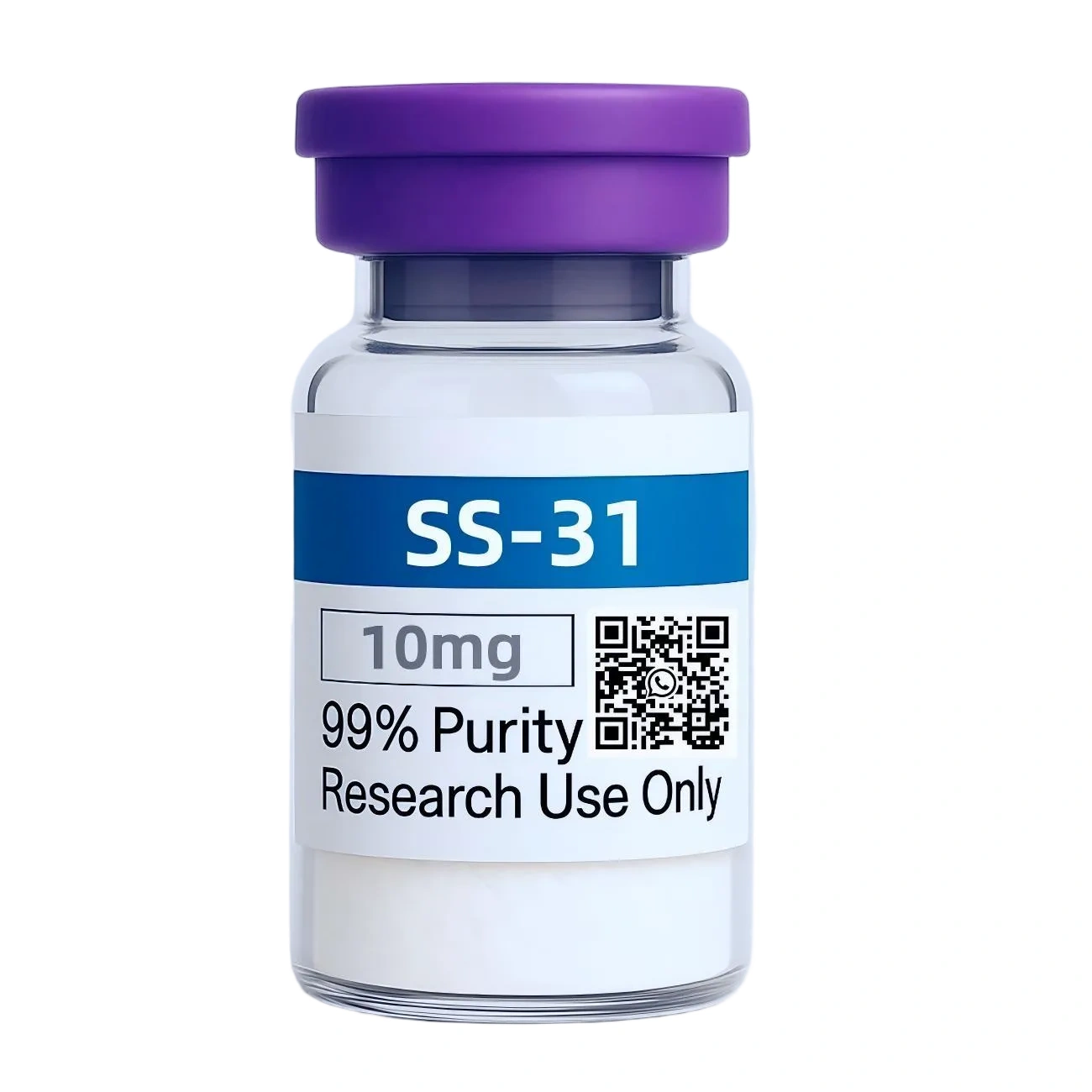
SS-31 (Szeto-Schiller tetrapeptide) for research. Mitochondria-targeting peptide sourced directly from China. Purity tested per batch.
SS-31 (elamipretide) is a mitochondria-targeted tetrapeptide with an established cardiovascular and neurodegenerative preclinical literature. It is a technically demanding synthesis for a china peptide manufacturer, and the gap between a competent SS-31 batch and a failed one is measurable in peptide content and residual solvent levels. Our sourcing model connects buyers to the factories that can actually make it — and documents that they did.
Buy SS-31 Peptide | Mitochondria-Targeting Tetrapeptide | Research Grade | Peptides of China SS-31 Buy SS-31 (Szeto-Schiller) — Mitochondria Research Peptide SS-31 is a energy & endurance research compound currently in stock directly from a verified Chinese manufacturer. Every batch is tested by the manufacturer for purity and concentration as part of routine quality control. Sourcing is direct — no intermediaries. Public catalog minimum is $300 in goods per supplier. Eligible new customers may use one first-order trial without a monetary minimum; 5% off goods applies from $3,500 per supplier, excluding shipping. International shipping available.
Compound Profile
SS-31 (also known as elamipretide or MTP-131) is a synthetic tetrapeptide belonging to the Szeto-Schiller (SS) peptide series, developed by Hazel Szeto and Peter Schiller at Weill Cornell Medical College. Its sequence — D-Arg-Dmt-Lys-Phe-NH₂ — incorporates two non-natural amino acids: D-arginine at position 1 (for metabolic stability) and 2’,6’-dimethyltyrosine (Dmt) at position 2, which confers potent free radical scavenging activity and high affinity for cardiolipin. Cardiolipin is an anionic phospholipid unique to the inner mitochondrial membrane (IMM), where it plays structural roles in cristae architecture, electron transport chain (ETC) complex assembly, and mitochondria-associated membrane (MAM) organisation. SS-31’s nanomolar affinity for cardiolipin allows it to concentrate approximately 1000-fold in mitochondria following systemic administration — its primary mechanism of action. Research on SS-31 centres on mitochondrial dysfunction as a unifying pathological mechanism across ageing, cardiovascular disease, kidney injury, and neurodegenerative conditions. By stabilising cardiolipin in the IMM, SS-31 prevents cytochrome c dissociation from the membrane, maintains cristae morphology, reduces electron leak (and thus ROS production), and preserves ATP synthase activity. In cardiac ischaemia-reperfusion (I/R) injury models, SS-31 reduces infarct size by up to 40% when administered at reperfusion — one of the most reproduced findings in mitochondria-targeted cardioprotection research. The compound has been evaluated in Phase II and III clinical trials for heart failure with reduced ejection fraction (HFREF), Barth syndrome (a mitochondrial cardiomyopathy caused by tafazzin gene mutations), and acute kidney injury. Peptides of China supplies SS-31 (elamipretide) as lyophilized powder at ≥98% purity, verified by HPLC and confirmed by mass spectrometry. Certificates of Analysis available per batch. Wholesale quantities on request. For laboratory research use only.
Profile
Available Variants
| Name | Strength | Pack Size | Purity | Availability |
|---|---|---|---|---|
| SS-31 | 10 mg | 10 vials | — | In Stock |
| SS-31 | 10 mg | 10 vials | ≥98% | In Stock |
| SS-31 | 50 mg | 10 vials | — | Out of Stock |
| SS-31 | 50 mg | 10 vials | ≥98% | In Stock |
Specification Highlights
Research Areas
Cardiac Ischaemia-Reperfusion Injury Cardiac ischaemia-reperfusion (I/R) injury is characterised by a burst of ROS and mitochondrial membrane permeability transition pore (mPTP) opening at reperfusion, causing cardiomyocyte death. SS-31 administered at reperfusion (0.05–1 mg/kg i.v. in rodent models) reduces infarct size (TTC staining), preserves mitochondrial membrane potential (ΔΨm, measured by JC-1 or TMRE), and attenuates cytochrome c release — all consequences of cardiolipin stabilisation and reduced electron leak. Ex vivo Langendorff perfused heart preparations allow precise control of I/R timing and SS-31 concentration, making this one of the cleanest assay systems in mitochondria-targeted pharmacology. Mitochondrial Bioenergetics & Ageing Mitochondrial dysfunction — reduced ATP production, elevated ROS, and fragmented cristae — is a hallmark of cellular ageing and senescence. SS-31 preserves ATP synthase activity by maintaining the cardiolipin-dependent supercomplex organisation of ETC complexes I, III, and IV (respirasome). In aged mouse models (24-month-old C57BL/6J), SS-31 treatment improves maximal oxygen consumption rate (OCR) in isolated mitochondria, increases muscle endurance on treadmill testing, and reduces 4-HNE adducts (a lipid peroxidation marker) in cardiac and skeletal muscle. These findings position SS-31 as a tool for studying whether mitochondrial cardiolipin remodelling is causal in age-related decline. Kidney & Acute Organ Injury Models Renal tubular epithelial cells (RTECs) are highly mitochondria-dependent due to their reliance on oxidative phosphorylation. In cisplatin-induced nephrotoxicity, renal I/R, and contrast-induced AKI rodent models, SS-31 reduces serum creatinine, BUN, and histological tubular injury scores. Mitochondria isolated from treated kidneys show preserved morphology (electron microscopy), higher ΔΨm, and reduced cytochrome c release. The EMPOWER trial investigated SS-31 in primary mitochondrial myopathy — a condition with no approved therapy — using 6-minute walk distance and functional endpoints in patients with documented mitochondrial mutations. Barth Syndrome & Cardiolipin Research Barth syndrome is caused by mutations in the tafazzin (TAZ) gene encoding a cardiolipin transacylase, leading to cardiolipin deficiency and abnormal monolysocardiolipin accumulation — making it the definitive genetic model for cardiolipin dysfunction. SS-31 in TAZ-knockdown cell lines and zebrafish models restores cristae morphology and mitochondrial ATP synthesis, providing direct functional validation of the cardiolipin-binding mechanism. The TAZPOWER Phase II trial evaluated SS-31 in Barth syndrome patients using cardiac MRI and exercise testing as endpoints. These studies remain the most mechanistically well-controlled clinical dataset for any cardiolipin-targeting compound. ## Sourcing SS-31 From China
SS-31 is available through our platform as a china peptide sourced directly from an established Chinese manufacturer. Three points define how we handle it:
- Factory-direct, not trader-sourced. We confirm availability and specification with the manufacturer before the order is confirmed. There is no intermediary resale of unknown-origin vials in this catalog.
- Specification before shipment. The purity and concentration specification shown on this page is the manufacturer’s batch specification. Product-specific quality-control information travels with the order.
- Research-use discipline. Like every listing in our catalog, SS-31 is supplied for laboratory research use only, under strict research-use terms.
For buyers comparing chinese peptides suppliers, the practical test is whether the seller can name the manufacturer and show the batch documentation. We work the other way around: the manufacturer and the documentation are the offer. Browse the full catalog or see how sourcing works.